Physics
Are you someone who鈥檚 interested in how things work? Do you want to examine the basic laws of nature and use them to explain how more complex systems work? Does the possibility of working as an automotive engineer or geophysicist or cardiac imaging researcher excite you?
Then a Physics degree might be for you. The Physics program from the College of Science and Mathematics鈥� Department of Physics prepares students for a variety of career pathways.
A Physics degree from 麻豆官网首页入口 offers a one-of-a-kind experience鈥� one that can lead to an exciting future of research and discovery.
Physics is for you if you consider yourself
What You'll Study
Coursework
Graduates of the Physics program take classes that create a strong foundation of physics understanding. Students are encouraged to augment that understanding by participating in undergraduate research. Not only will that solidify comprehension of the material, it will impress potential employers or graduate programs.
Course List | |
Experience-based Education
Outside the Classroom
With several departmental research projects in areas including astrophysics, atomic and molecular physics, condensed matter physics, applied physics, and nuclear physics, you have plenty of opportunities to get important research experience.
State-of-the-art instrumentation creates an engaging laboratory experience, enhanced by the high level of access students have to faculty members.
Meet-and-greets, departmental outreach activities, and clubs (physics club, makers club, and scholar of nuclear physics club) help you with networking and service opportunities.
Research & Innovation
Whether you鈥檙e an undergraduate or graduate student, you鈥檒l have opportunities to create your own research projects or work with faculty to tackle some of the world鈥檚 most complex and pressing challenges.
Physics Clinic
Clinic hours to specifically help you with your introductory physics and laboratories. They run in the Science and Mathematics building on the Health Sciences campus.
New Home
A new, state-of-the-art building with 22 teaching labs, a tutoring center and a top floor dedicated to research is located on the Health Sciences Campus, maximizing educational and research opportunities.
Your Future
Career Options
Graduates of the Physics program can pursue a variety of exciting careers, including astronomy, health physics, engineering, and nuclear physics, with many of these employment opportunities in the 麻豆官网首页入口 area. Those wishing to move on to graduate and professional programs can choose from an even more select list of occupations.

Why 麻豆官网首页入口?
A new building in the heart of the Health Sciences Campus puts Physics students in the middle of the university鈥檚 research enterprise, maximizing opportunities for internships and mentorships.
A full range of student support services exist to make sure that students have the opportunity to find assistance, advice or mentorship.
Easy access to faculty ensures students receive the individual attention and mentorship opportunities they need to help them stand out when moving into their careers or on to the next academic challenge.
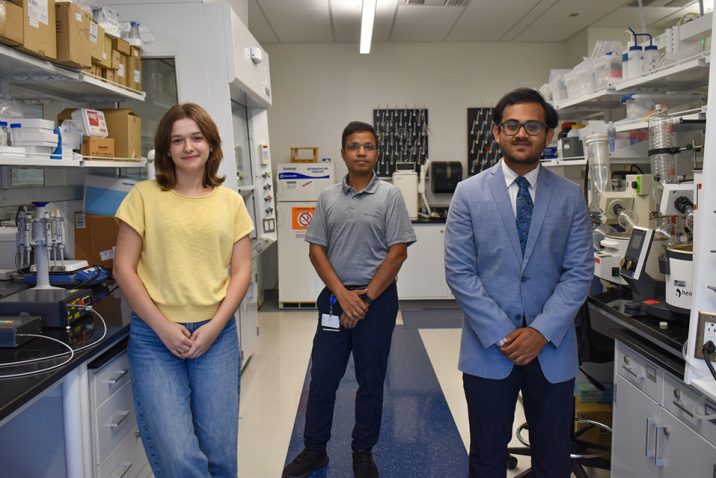
AU undergraduate research team selected for national advocacy program

Delta Chi members earn national NIC Awards of Distinction聽